Tuesday, June 9, 2015

Unit 3: Matrices and Transformation (Chapter 9 & 14)

Matrices is an array/ordered arrangement of numbers.

This is one of the example of what matrices look like:
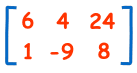


And this is one of the examples of adding in matrices

To add the two matrices given below, we can add the numbers with matching position
(example source: Math is Fun)
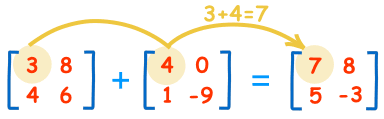


The calculations work like:
3 + 4 = 7        8 + 0     = 8
4 + 1 = 5        4 + (-9) = 5

This is one of the examples of subtracting in matrices
To subtract two matrices: we can do it the same way as adding (subtract with each same position)
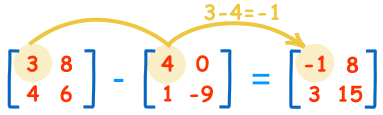


The calculations work like:
3 - 4 = -1        8 - 0     = 8
4 - 1 =  3        6 - (-9) = 15

Chapter 9:01
Defining a matrix, and Some Matrix operations
The example of how to do it is shown above.
Some matrix also comes with a story. For example a there are 8 people, 3 of them are 12 - 15 years old, and the rest are above 16 years old.
For example they go to a supermarket one by one, and we can make the data of who went there first.

Chapter 14
14:01 Translations
This is one of the example of how to do translations


From rotation, we can obviously turn it, as in just fold the graph or paper so it would look the same.
From reflection, it's really obvious to just put it together because it's face to face with each other and it has the same figure.
From translation, by slide, we can just stack it together so it would fit with each other.

Unit 2: Curve Sketching (Chapter 4, 6, 8)

What is curve sketching?
Curve sketching can be make in accurate sketch of lots of function using the concepts.

Chapter 4 (Number Plane Graphs and Coordinate Geometry)
4:01 Parabola
Most graphs are straight line but this is mathematical curve called the parabola.
The parabola equations are called quadratic equations and have x2 as the highest power of x.
But this is the simplest equation: y = x2

Here is one of the exercise I solved:
a) Complete the following tables and then graph all four curves on one number plane. (On the y-axis, use values from -2 to 13.

-> y = x2

x-3-2-10123
y410149

4:02 (Parabolas of the Form y = ax2 + bx + c 
It says that all parabolas have the same basic shape.
The connection between the parabola's shape and its equation and at what numbers in the equation influenced the steepness of it.

4:03 (The Hyperbola)
We need to take many points when graphing a curve like y = 2/x, as it has two separate parts. The equation is called a hyperbola. 
This is one of the example of how to solve the problem

x-4-3-2-1-0.500.051234
y-0.5-0.7-1-2-4-4210.70.5

So the as you can see there is no value for x = 0. because when x = 0, y = 2/x becomes y = 2/0. 
This value cannot exist as no number can be divided by 0. 

Chapter 6 (Curve Sketching)
6:01 Curves of the Form y = axn and y = axn + d
The method used to graph a curve has relied on using the equation of the curve to produce a table of values. This gave a set of points on the curve, which this could be plotted. This procedure is basic to curve sketching. It's the only way to producing an accurate graph of a curve.

When it's impossible to draw a right graph, a sketch is being made.

This is one of the curve sketch example


and here is one of the example of how to do the problem

1. y = -2(x - 4)(x - 4)(x + 2)

answer:
1. the curve has x-intercepts x = 1
    we need to consider the size of y when x is bigger than 4 and less than -2 gives the correct shape.


Sunday, June 7, 2015

Unit 1: Quadratic Equations (Chapter 3&5)

Chapter 3:
What is quadratic equation?
Quadratic equation is an equation where a high exponent of the variable (x) is a square, it is known to 2.
Formula: 2x2+5x-3 = 0

3:01 (Solution Using Factors)
This is one of the example of how to solve a problem
1. (x - 1) (x + 7) = 0
Answer:
1. If (x - 1) (x + 7) = 0 then either
x - 1 = 0 or x + 7 = 0
Final answer:
It can be x = 1 or x = -7

3:02 (Solution by Completing the Completing the Square)
This part completes an algebraic expression to form a perfect square, which the expression is (x + a)2 or (x - a)2.

This is one of the example of how to solve a problem
1. What must be added to the following to make a perfect square?
    x2 - 5x
Answer:
1. Half of 8 is 4, so the perfect square is=
    x2 + 8x + 4*2 = (x + 4)2

3:03 (The Quadratic Formula)
What is a quadratic Formula:
The quadratic formula is mainly used in algebra to solve a quadratic equations. The normal for of a quadratic equations is where "x" shows a variable, and a, b, and c are constants. A quadratic equations have 2 solutions which we can also call it roots.

3:04 (Choosing the Best Method)
Many quadratic equations appear in various different forms. They can always be simplified to the general form of ax2 + bx + c = 0.

This is one of the example of how to solve a problem
1. x(x - 5) = 6
Answer:
1. x(x - 5) = 6
    x2 - 5x = 6
    x2 - 5x - 6 = 0
Factorising gives:
(x - 6)(x + 1) = 0
                   x = 6 or -1

Chapter 5: Further Algebra
5:01 (Simultaneous Equations Involving a Quadratic Equation)

What is Simultaneous Equations Involving a Quadratic Equation?
Simultaneous Equations Involving a Quadratic Equation is how a solution of a linear equation and a quadratic equation is provided by a point (or more points) of intersection of the line and parabola representing the equations.

To find the solution, we need to eliminate y (or x) by substitution, and solve the quadratic equation though it's formed in x (or y). Then we can find the corresponding value of y or x.